



Falling dry – what is that exactly? You might well ask, unless you’re from the north of the Netherlands or experienced with ships in the Wadden Sea. Falling dry is something that fits perfectly with our times:
- For many people, a once-in-a-lifetime and truly unique experience
- Back to nature and a deeper connection with the environment
- Relax and take your time – there’s nowhere else you need to be
- It’s off-grid
But what exactly is falling dry? To understand that, you need a bit more background – on two specific topics: traditional sailing ships and the sea with its seabed. Two subjects that fit perfectly with Rederij van Linschoten. Falling dry is one of the favorite parts of sailing on large, traditional ships.
The Ships
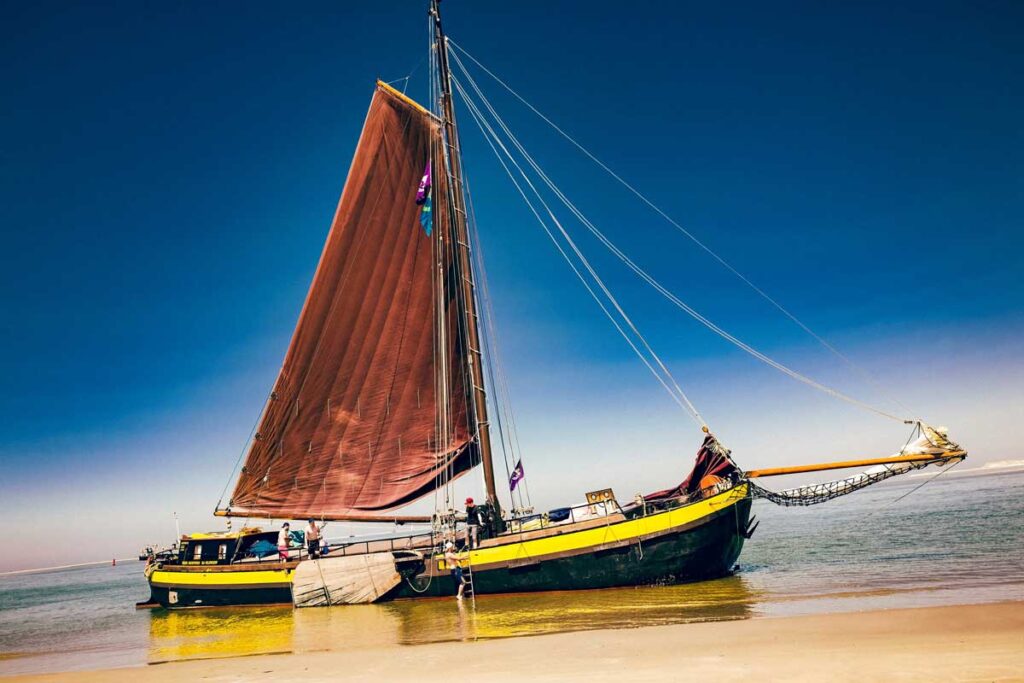
Let’s start with the ships. The Netherlands has a lot of water. In earlier times, before we had excellent roads and rail connections, much of the freight was transported by water. Large, steel, and impressive ships sailed with all kinds of cargo across the Wadden Sea, the then-existing Zuiderzee, and the rivers, canals, and lakes of the Netherlands. It was a relatively fast and inexpensive way to move goods.
The more cargo a captain could carry, the better it was for his wallet. So, the bigger the ship, the more freight it could transport. The waters of the Netherlands, however, are generally quite shallow, and in earlier times many areas were only between 1.2 and 3 meters deep. A ship with a deep draft simply couldn’t navigate the inland waters. And of course, the more cargo, the deeper the ship sat in the water. But of course, they still wanted to carry as much as possible in a single trip…
The clever Dutch developed relatively wide and shallow ships to solve this problem. They could carry a lot of cargo without sitting too deep in the water and running aground. These ships are commonly called flat-bottomed ships; they have a flat hull and are wide. Because of these two features, they can even ‘stand’ on land on their bottoms without tipping over. One extra detail: they have no keel. To prevent being blown sideways when the wind filled their sails, they have large planks on each side called ‘leeboards.’ By lowering one into the water, the ship gains forward speed instead of drifting sideways. Now you know what those quirky side planks are for – and no, they’re not for flying 😉.
The Wadden Sea
Next, you need to know a bit about the sea. As everyone knows, the sea has tides: ebb and flow. The water comes in and goes out, caused by the gravitational pull of the sun and moon. The difference between high and low tide in the Netherlands is around 2 meters. Our beautiful UNESCO World Heritage site, the Wadden Sea, also experiences tides. The Wadden Sea stretches from Den Helder all the way to Denmark. In many places, the tides expose large parts of the seabed at low water—you can see the sandbanks. It’s a stunning sight, resembling a vast beach crisscrossed with large and small tidal channels.
The process of falling dry
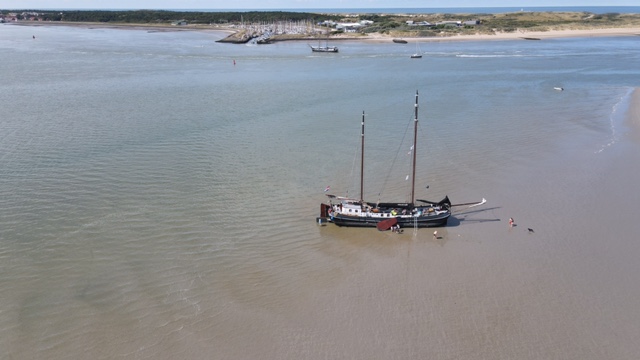
Now we finally come to falling dry. By now it’s clear: these large, wide, flat-bottomed ships can sail over a sandbank at high tide. And when the tide goes out (low water), the entire ship rests dry on the sandbank—the seabed!
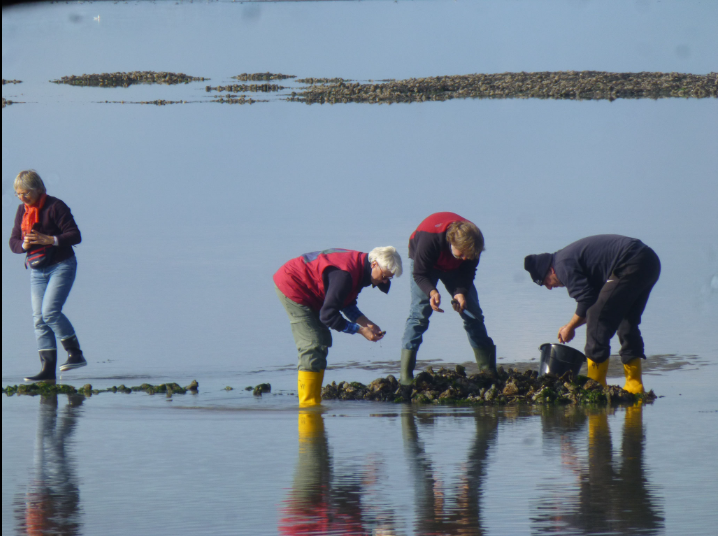
Falling dry, of course, doesn’t happen in an instant. It takes a little while after the ship has grounded for all the water around it to drain away. But once the water is gone, you have one to two hours to walk freely over the seabed—a truly unique experience. Right in the middle of the sea, you can stroll across the sand or through the mud along the tidal channels.
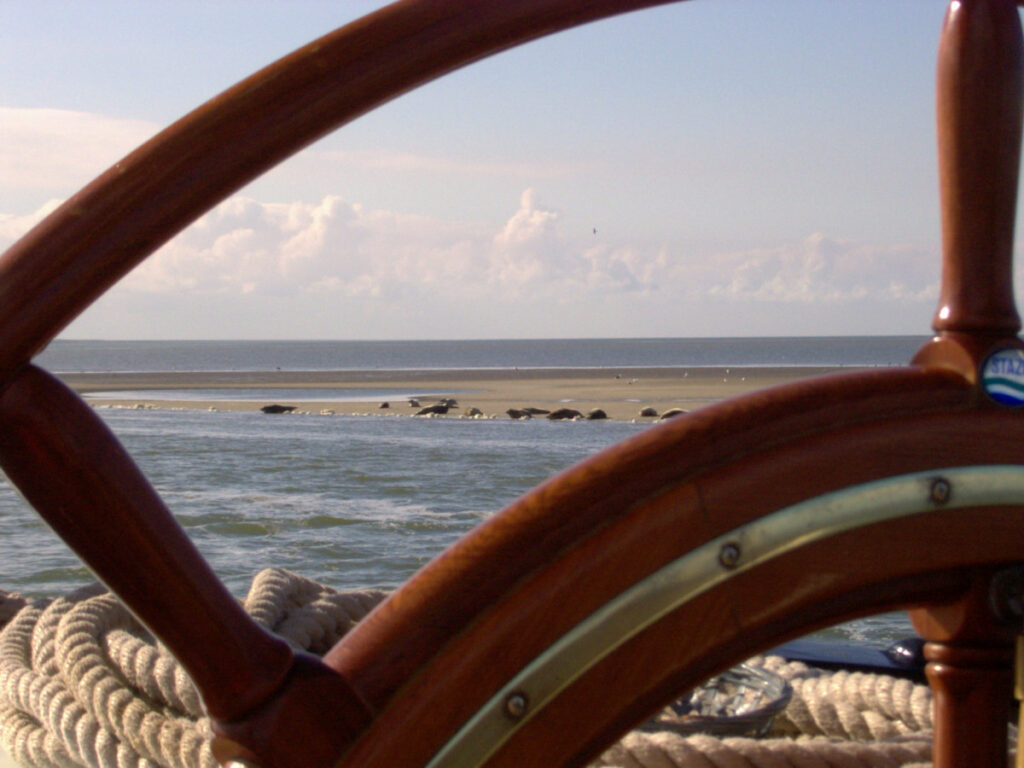
You’re never alone on a sandbank; it’s a hive of activity: foraging birds, shellfish, and all kinds of marine creatures. Sometimes you might even find a few mussels, razor clams, samphire, cockles, or even oysters. And every now and then, a seal rests in the distance or comes by for a quick look before the ship falls dry.
Falling dry is one of the most unique experiences you can have—a natural phenomenon that you are a part of yourself. Is it already on your bucket list? Have you ever fallen dry on a ship? Then you know better than anyone that you’ll want to do it again. That’s why you can book a falling-dry trip on one of the Wadden Sea ships with Rederij van Linschoten. (Check out the sailing trips and choose the ‘Wadden Sea’ area, or book one of our ships for your group trip.)